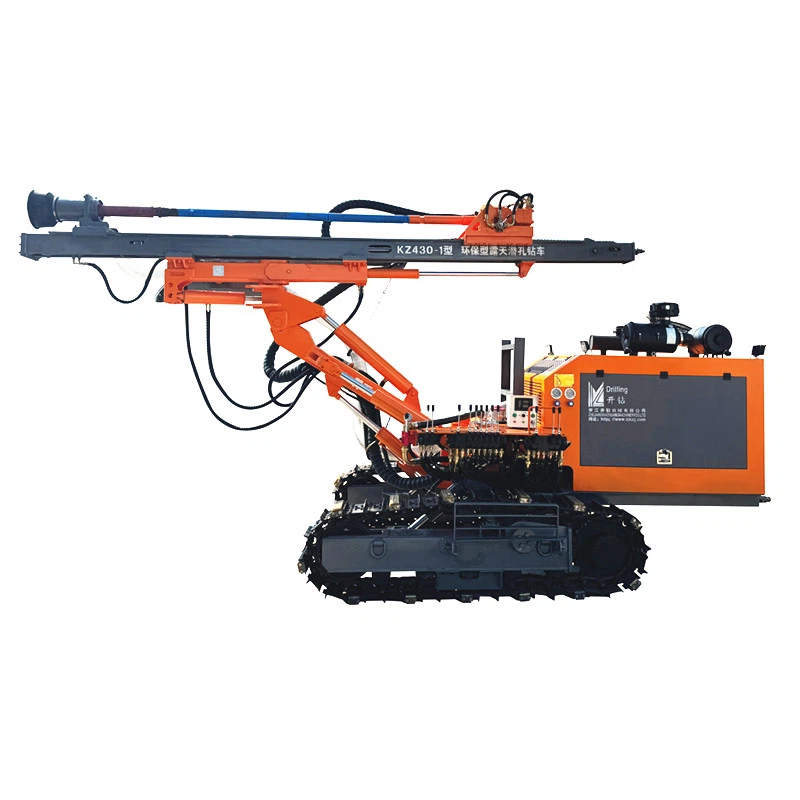
Essential Industry Knowledge of Mining DTH Blast Hole Drills
Mining DTH (Down-The-Hole) blast hole drills are core production equipment for both open-pit and underground mining, specifically designed for drilling blast holes. Their operational quality and efficiency directly determine a mine's production capacity and economic benefits.
Core Positioning and Key Requirements
The primary task of this equipment is to drill blast holes at specified locations that meet the blast design requirements for depth, diameter, angle, and spacing. Consequently, it demands extremely high standards for drilling accuracy, hole completion efficiency, and equipment reliability. Vertical deviation is typically required to be controlled within 1% to ensure even distribution of explosive energy and avoid issues like "toes" or "flyrock."
Technical Configuration and Performance Characteristics
To meet the demanding conditions of high-intensity, continuous mining operations, DTH blast hole drills typically possess the following features:
Large-Diameter Deep Hole Capability: Mainstream hole diameters range from 90-250 mm, with depths reaching over 30 meters, satisfying the needs of large-scale bench blasting.
High-Efficiency Power and Impact System: Equipped with large-displacement screw air compressors providing high-pressure air at 1.2-3.5 MPa, driving high-impact energy DTH hammers to ensure drilling speed in hard rock formations (such as granite, magnetite).
High Stability and Intelligent Control: Utilizing heavy-duty crawler undercarriages and rigid masts ensures stability during slope operations. Advanced models integrate GPS automatic hole positioning systems and automatic depth control. Operators can complete the entire process-from positioning and leveling to drilling-from within the cab, increasing efficiency by over 30% compared to manual operation, with hole positioning accuracy reaching centimeter-level.
Economics and Management Core
In mining production, the drill rig is a key link for "reducing costs and increasing efficiency." The core economic indicator is the "cost per meter drilled," which comprises equipment depreciation, energy consumption (diesel/electricity), consumable parts (drill bits, drill pipes) costs, and maintenance expenses. Scientific equipment management-such as optimizing bit selection based on rock formation changes and utilizing IoT data for predictive maintenance to reduce unplanned downtime-can lower overall costs by 15-25%.
With the advancement of "smart mining" and green extraction concepts, DTH blast hole drills are evolving towards remote control, unmanned operation, and electrification, aiming to further enhance operational safety, reduce carbon emissions, and achieve integrated management of production data throughout the entire process.