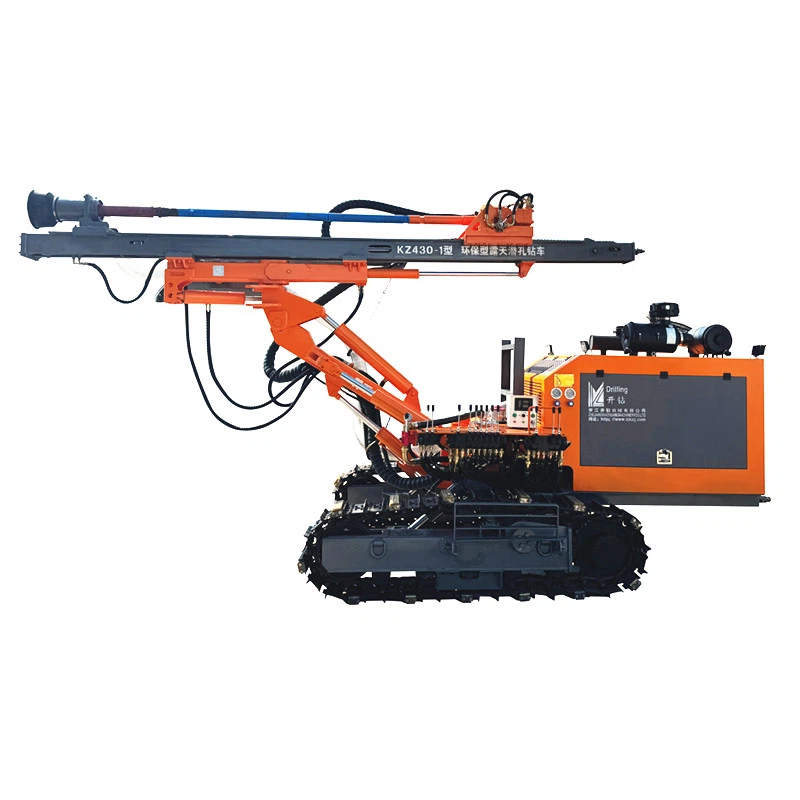
The slope support DTH drilling rig is a specialized drilling equipment used for reinforcement projects such as mountain slopes, mine pit slopes, and roadbed slopes. Its core function is to drill high-precision, specific-angle deep holes on unstable slopes, providing channels for installing support components like anchor rods, anchor cables, and grouting pipes. It is a critical piece of equipment for geological hazard prevention and engineering safety.
Core Tasks and Technical Challenges
Unlike traditional vertical drilling, slope support drilling rigs face two main challenges:
Complex Angle Construction: It is necessary to drill horizontal, upward-inclined, or downward-inclined holes on slopes, typically within an angle range of 0° to 30° (upward inclination), placing extremely high demands on the mast adjustment range and equipment stability.
Operating in Fragmented/Unstable Formations: Slope rock masses are often fracture zones or weathered layers, prone to hole collapse and rod sticking. Therefore, the equipment must have casing-while-drilling capability (simultaneously drilling and installing casing to protect the hole wall) and employ low-disturbance drilling techniques.
Key Performance and Configuration Features
To address the above challenges, this type of drilling rig requires the following key capabilities:
Multi-Functional Mast: Equipped with a widely adjustable mast (typically from -15° to +30° or more); some models feature an articulated arm design for flexible positioning in complex terrain.
High-Precision Guidance System: Integrates inclination sensors and azimuth indicators to ensure the drilling trajectory precisely matches the design, with angular deviation often required to be less than 0.5°.
Efficient Cuttings Removal and Wall Protection: Utilizes high-pressure, high-volume air compressors (air pressure often 1.5-2.5 MPa) for powerful hole cleaning and cuttings removal. It can also be optionally equipped with a dual power head to achieve simultaneous casing advancement, preventing hole collapse.
Compactness and Mobility: Mostly crawler-mounted or truck-mounted, with low ground pressure, adapting to narrow and steep slope construction platforms.
Economics and Management Core
Its economic core lies in hole completion quality and construction efficiency. The first-pass hole qualification rate directly determines whether support materials (such as expensive pre-stressed anchor cables) can be smoothly installed and perform effectively. Scientific drill bit selection (e.g., using button bits or diamond bits for different formations), optimized drilling parameters (rotation speed/air pressure), and the equipment's rapid positioning and relocation capabilities are key to controlling overall costs. With technological advancement, functions like automatic rod changing and remote control are gradually becoming more common to enhance safety during operations on hazardous slopes.
This equipment is the critical link connecting survey/design and engineering implementation. Its level of specialization directly relates to the final safety and durability of slope treatment projects.