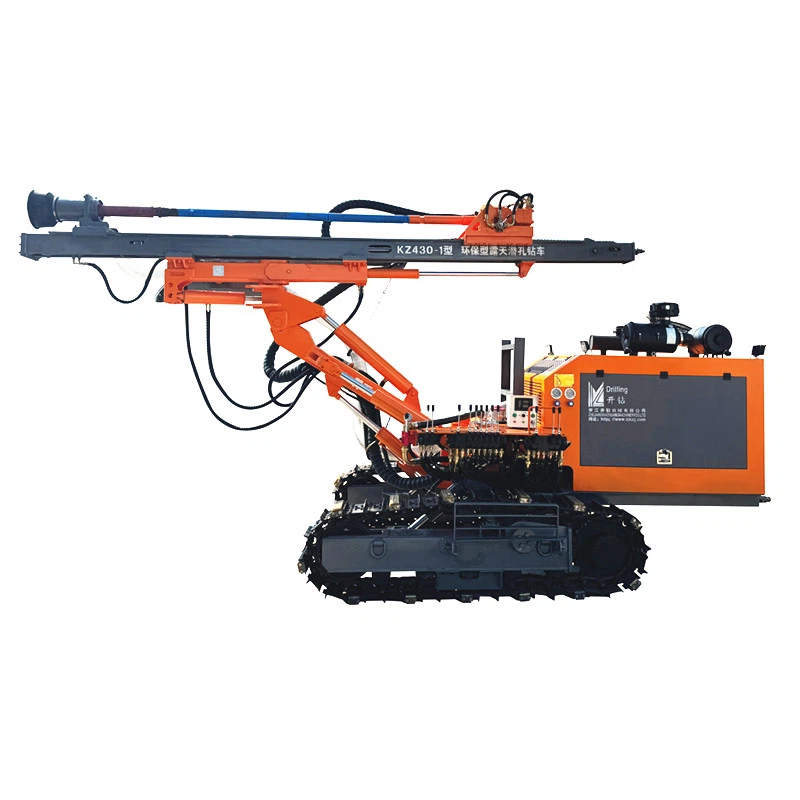
In the field of drilling, there are two main types of drilling rigs, each with distinct drilling capabilities and applications. In this blog, let's delve into these two distinctions to help you choose the one that best suits your drilling needs.
1.
working principle
Crawler-type down-the-hole drill: It adopts a percussion-rotary method, transmitting impact force to the drill bit through the drill rod while simultaneously rotating the drill bit to break rocks. The impactor is usually located near the drill bit (down-the-hole), ensuring high energy transmission efficiency and suitable for medium to deep-hole operations.
Rock drill: Primarily relying on high-frequency impact (such as pneumatic or hydraulic drive), it transfers the impact force to the drill bit through the drill rod, with weaker rotational action or requiring auxiliary equipment to complete. It is suitable for shallow or small-diameter drilling.
2.
Drill capacity
Crawler-type down-the-hole drill: It has a large drilling diameter (typically 80-200mm) and can drill to depths of up to tens of meters, making it suitable for medium and deep-hole requirements such as mining and slope support.
Rock drill: It has a relatively small hole diameter (generally less than 50mm) and shallow depth, and is mostly used in tunnel boring, secondary crushing, and other scenarios.
3.
Equipment composition and mobility
Crawler-type down-the-hole drill
High independence: Equipped with a tracked chassis and power system, it can move independently and adapt to complex terrains (such as open-pit mines and slope operations).
Integrated design: Typically incorporating a down-the-hole hammer, dust removal device, and hydraulic control system, eliminating the need for additional auxiliary equipment.

Jumbo
Modular structure: composed of a trolley chassis, rock drill arms (multiple rock drills), and an operating platform, relying on external power or hydraulic stations (such as fixed power supply in tunnels).
Restricted mobility: Although it has the ability to walk, it is mostly used in fixed or semi fixed scenarios (such as tunnel excavation), and its flexibility is lower than that of tracked equipment.
4.
Cost and Maintenance
Crawler type down the hole drilling rig: low purchase cost, relatively simple maintenance (long life of impactor), high efficiency, low energy consumption, suitable for long-term large-scale projects.
Rock drilling rig: The initial investment is relatively high, and for small hole diameters (50mm), it is more efficient than tracked down the hole drilling rigs to meet the construction schedule. However, the wear and tear of rock drilling tools is fast, and the maintenance cost is high.
5.
Applicable scenarios
Crawler-type down-the-hole drill
Typical applications: open-pit mining, slope anchoring, and deep hole operations in hydroelectric power plant excavations.
Advantages: Strong adaptability to rock hardness (especially for medium hard and above rock layers), high drilling accuracy.

Jumbo
Typical applications: narrow space operations such as tunnel excavation, underground mining, and subway construction.
Advantages: Multi arm collaboration, flexible positioning, suitable for complex cross-section drilling needs.