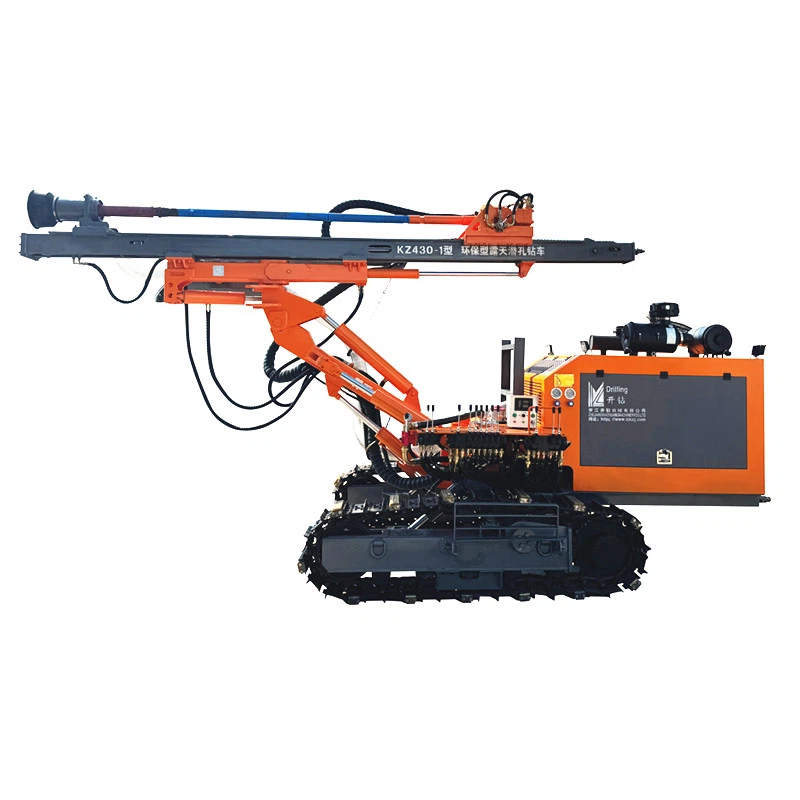
Pneumatic type:
The pneumatic type uses compressed air to drive the piston forward in the cylinder, allowing the steel chisel to strike rocks, and is the most widely used.
Electric type:
The electric type is driven by an electric motor through a crank connecting rod mechanism to impact the steel chisel and chisel rocks. And use the powder discharge mechanism to discharge the stone chips. The internal combustion engine uses the principle of internal combustion engine to drive the piston to impact the steel chisel and chisel the rock through the explosive force of gasoline. Suitable for construction sites without power or gas sources.
Hydraulic type:
Hydraulic type relies on hydraulic pressure to impact steel drills through inert gas and impact bodies, chiseling rocks. The impact mechanism of these rock drills forces the steel drill to rotate at an angle during the return stroke, causing the drill bit to change position and continue chiseling the rock. By driving the piston to impact the steel drill rod through the explosive force of diesel, it continuously impacts and rotates, and uses the powder discharge mechanism to discharge stone chips, which can be drilled into a blast hole. Hydraulic rock drills, as one of the important engineering equipment, are indispensable in construction projects such as mines, highways, and buildings. However, while the rock drilling industry continues to develop, domestically produced hydraulic rock drills still suffer from low efficiency, short service life of some structures and components, lack of vibration reduction devices during operation, resulting in high vibration and low energy transfer efficiency.
Internal combustion type:
Internal combustion rock drills do not require replacement of internal parts of the head, only the handle needs to be moved according to requirements to operate. It has the characteristics of easy operation, time-saving, labor-saving, fast chiseling speed, and high efficiency. Drilling holes in rocks can be done vertically downwards, horizontally upwards at an angle of less than 45 degrees, and vertically downwards at a maximum depth of six meters. This machine can work in both high mountains and flat areas, as well as in hot regions of 40°C or extremely cold regions of minus 40°C. It has a wide range of adaptability.
Internal combustion rock drills have various functions such as mining drilling, construction, cement pavement, asphalt pavement, etc. They are widely used in mining, construction, fire protection, geological exploration, road construction, quarrying, construction, national defense engineering, etc.