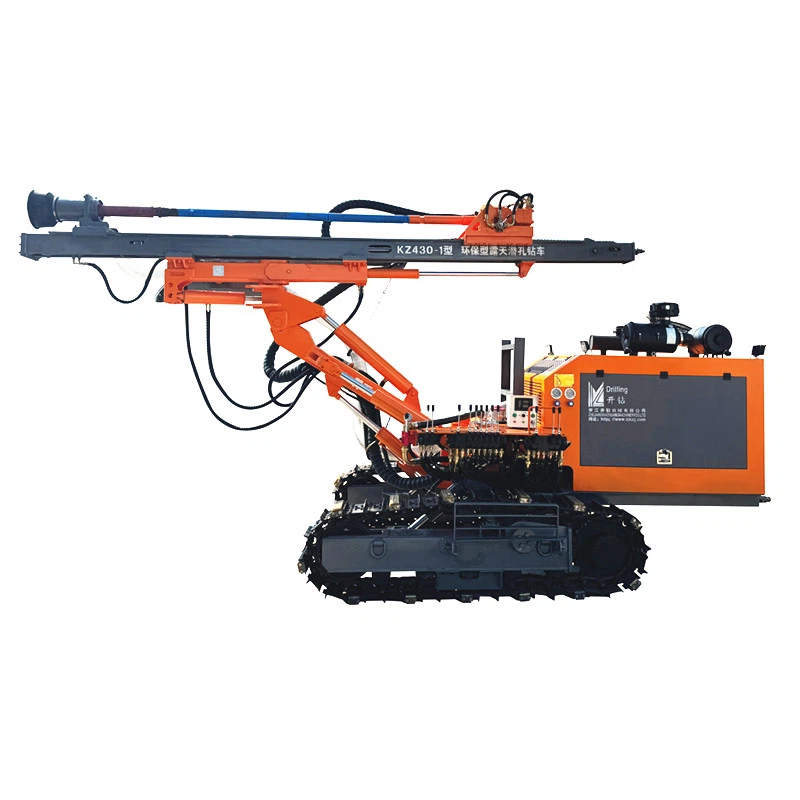
As an important splitting equipment for rock excavation and mining in construction sites, the excavator drilling rig has been widely used. Drilling machinery reminds everyone to check the safety of the drilling rig before excavation, drilling, and use. Only after passing the inspection can it be used on the construction site. The main structure of the drilling rig, structural connection bolts, structural connection pin shafts, welding seams of each structural component, basket structure, and safety protection should be checked in a timely manner. Any details with problems cannot be ignored.
Before using the excavation and renovation drilling rig, its safety should be checked, and it can only be used after passing the inspection. Especially before entering the site for use, qualified units should be invited to test its safety functions, and only after passing the inspection can it be put into use.
The main advantages of mining to drilling are:
1. Fast drilling speed: Compared with traditional circulating drilling machines, it has obvious advantages, which effectively ensures the development of the project.
2. Outstanding environmental protection features: Compared with traditional circular drilling rigs, rotary drilling rigs differ in that they can recycle mud, while traditional circular drilling rigs constantly release mud.
3. Walking and shifting convenience: The track structure of the rotary drilling rig can move the rig to the desired position in a convenient manner, unlike traditional cyclic drilling rig shifting which is as cumbersome.
4. Accurate alignment of pile holes: This is something that traditional circular drilling machines cannot achieve. During the alignment process, the operator can use advanced electronic devices in the control room to accurately complete the alignment, allowing the drilling machine to reach the drilling situation.
Before using the excavator, its safety should be checked and it can only be used after passing the inspection.
Most of the fixing or connecting bolts in various parts of construction machinery have tightening torque requirements, such as fuel injector fixing bolts, cylinder head bolts, connecting rod bolts, flywheel bolts, etc. Some specify the tightening torque, some specify the tightening point, and also specify the tightening sequence. Some repair personnel think that anyone can tighten the bolts and it doesn't matter, so they don't tighten them according to the prescribed torque and sequence (some don't even understand the requirements for tightening torque and sequence), don't use torque (in kilograms) wrenches, or randomly use force rods to tighten them based on feeling, resulting in significant differences in tightening torque.
Lack of torque can cause bolts to loosen, leading to damage to cylinder liners, loosening of bearing shells, oil leakage, and air leakage; Excessive torque can cause bolts to stretch and deform, even breaking, and sometimes damaging threaded holes, affecting the quality of repairs.
One loader, the torque converter throws hydraulic oil outward. After inspection, it was found that the 24 bolts connecting the pump wheel and the cover wheel were not tightened in the correct order and torque. Therefore, when repairing construction machinery, bolts should be tightened according to regular torque and sequence to prevent mechanical problems caused by excessive or insufficient bolt tightening torque or improper sequence.